The Ibalong is a sixty-stanza fragment of a Bicolano folk epic. What survives is a piece of something much longer, carried in memory for generations and written down almost by accident.
How the text survived
The epic was passed on orally until Fray Bernardino de Melendreras de la Trinidad (1815 to 1867), a Franciscan missionary stationed at Guinobatan in Albay, met a travelling bard named Kadunung and took the narrative down. Melendreras rendered it into Spanish verse inside Ibal, a 400-page manuscript on the customs of the Albay indios.
In 1895 a sixty-stanza portion appeared in Fray Jose Castaño's treatise on the Bicol region, without any credit to Melendreras. That fragment is what the modern world knows as the Ibalong. A full English translation did not appear until 1996, by Merito B. Espinas in the Far Eastern University Faculty Journal.
The epic places itself in the land of Aslon and Ibalong, a Bicol of roughly four and a half thousand years ago: thick jungle, rivers full of fish, and a horizon of hills and volcanoes. Scholars have long noted its debt to the Ramayana and the Mahabharata, and Baltog himself arrives from Boltavara, understood as India.
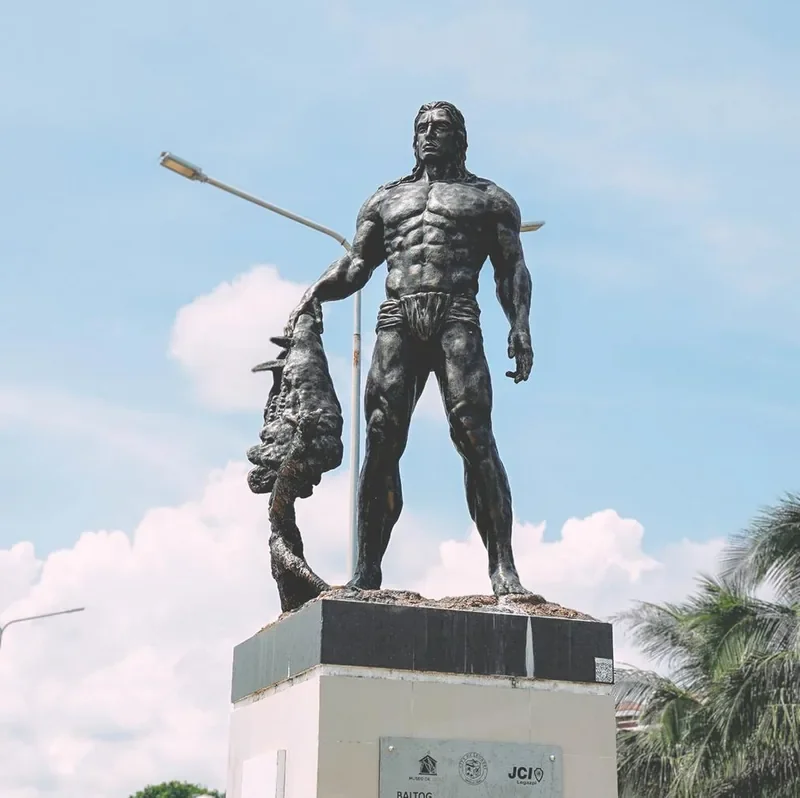
Baltog and the boar
Baltog plants a patch of taro, called linsa, at Tondol, in the modern town of Camalig. One night the Tandayag na Uson, a giant wild boar, roots the whole patch out. Baltog tracks it, kills it with his bare hands, and hangs the jawbones on the talisay tree in front of his house at Tondol, where people come to look at them. He is made chief of the hunters.
It is a small story to open an epic with. A man defends his vegetables. That scale is deliberate, and the rest of the text keeps it.
Handyong, and the age he made
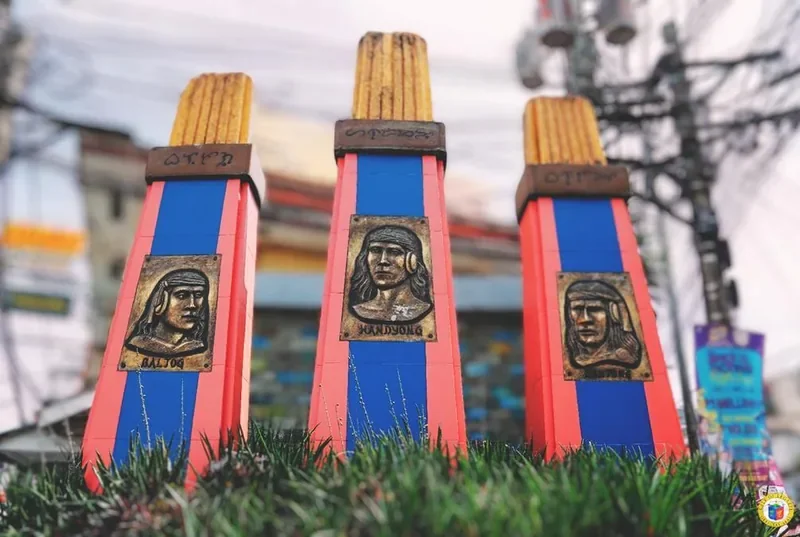
Handyong comes after Baltog and becomes the most famous of the tawong-lipod. The first half of his story is clearance: a long campaign against the creatures holding the land.
He does not do it alone. Oryol is a serpent who appears as a beautiful woman with a voice made for luring men to their deaths, and she begins as his adversary. But she comes to admire his courage, and changes sides. Together they clear the region until there is peace in the whole of Ibalong. The epic's most quoted idea sits here: the working harmony of opposites, an enemy who becomes the reason the work succeeds.
Then the inventions begin, and the epic starts naming people who never fight anyone:
- Dinahong, whose name means wrapped with leaves, made the first pottery and taught cooking.
- Ginantong made the plough, the harrow and the rest of the farming tools.
- Hablom built the first loom, and the first abaca cloth came off it.
- Kimantong fashioned the rudder, the sail, the plough and the systems of measure.
- Sural, from surat, to write, cut the first syllabary into a slab of white rock from Libong.
Handyong writes laws, plants linsa and rice, tames the wild carabao, and builds houses in the treetops. The text calls this a golden age, and the detail it chooses to prove it is that even slaves were respected under his laws.
The bestiary
The creatures of the Ibalong are specific, and most of them are dealt with by relocation rather than slaughter.
Tandayag na Uson
The giant boar of the taro patch. Killed by Baltog with his hands.
Angongolood
Hideous apes that ambushed people with an embrace and turned them into trees.
Buring
One eye, three throats. It lived in the swampy wastes of Ponong.
Sarimao
Avenging monsters that hunted hidden guilt. Handyong exiled them to Mount Kulasi.
The serpents
Probably Oryol's kin. Handyong sealed them inside a cave in Mount Hantik rather than killing them.
Tiburon
Giant flying fish, scaled and slimy, with saw teeth that could crush rock.
Winged sharks
Manta rays, breaking the surface like bats. Handyong drove them back.
Rabot
Half human, half monster, able to turn people to stone. Bantong killed it alone.
Bantong and Rabot
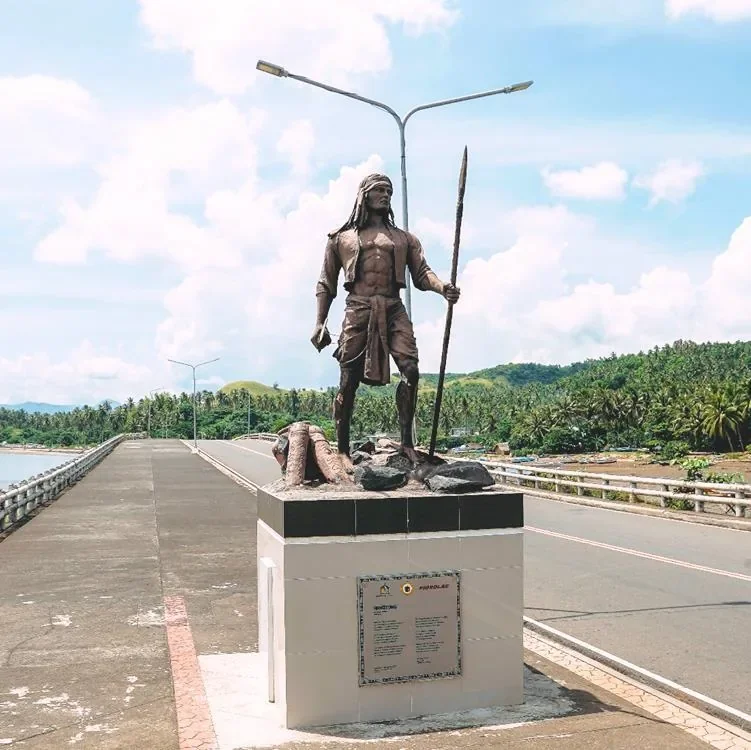
Bantong is the last hero, brave and cunning and young. Handyong gives him a thousand warriors to take on Rabot. He goes in by himself with a bolo and kills it, and the cheering carries through the forests and the mangrove swamps.
The flood, and the shape of Bicol
Then Unos frees a great flood, and the epic turns into a geography lesson. Hantik, Kulasi and Isarog erupt at once. Land sinks and land rises. Lake Buhi is formed. A strip of coast lifts at Pasacao in Camarines Sur. The Dagatnong settlement on Kalabangan Gulf is wiped out entirely. Malbogong Islet appears in the Bicol River, the Inarihan River changes course, and a mountain at Bato drops away to leave a lake.
Takay, a young woman, drowns in that flood, and becomes the water hyacinth that still covers Lake Bato. The volcanoes carry their own meanings through the text: Aslong, faintly visible, famous for enchantment; Asog, now Mount Iriga; Hantik, named for the giant ants in its Kalupnitan caves; Isarog, from isaro, to put together, where the forest people fled; and Masaraga, a glaring flame, where the Sarimao kept their cave.
Ibalong grows powerful again under an older Handyong. And then the fragment ends.
The ending nobody can explain
The last monster is dead, the land is at peace, and Handyong is grieving. The text gives no reason, and that abruptness is partly why the fragment is so argued over.
The scholar Ma. Lilia F. Realubit suggested he was mourning the passing of an era, when men were proved men by monsters and the skill of the hunt, when magic and ceremonial incantations infused life. Others read it as foresight: that he saw a new age coming, or even the subjugation of his people under a less benevolent ruler, which is what arrived with Spanish rule.
Whatever the intent, the epic refuses a triumphant ending. The monsters were the easy part.
The festival
The Ibalong Festival has been held in Legazpi every August since 1991, and it is genuinely unusual among Philippine festivals in having no religious frame. The Spanish introduced saints and fiestas across the archipelago; this one commemorates a pre-colonial story instead, and the geography of Ibalon along with it.
Performers take the roles of the heroes and the monsters, and the streets carry the epic in song and dance for a week. What the festival is actually marking is resilience: the region sits in the path of the typhoons, and the story it chose to keep is one about rebuilding after the flood.
The Ibalong stands apart from the other Philippine epics for what it leaves out. There is no violence against another people in it. Its subject is upland and lowland planting, houses in the treetops, a tree trunk hollowed into the region's first boat, tools and wares and just laws, and the invention of writing. It is a founding epic about learning to live somewhere.